

Iranian National Standard No. 12723 for Mechanical Rebar Splices
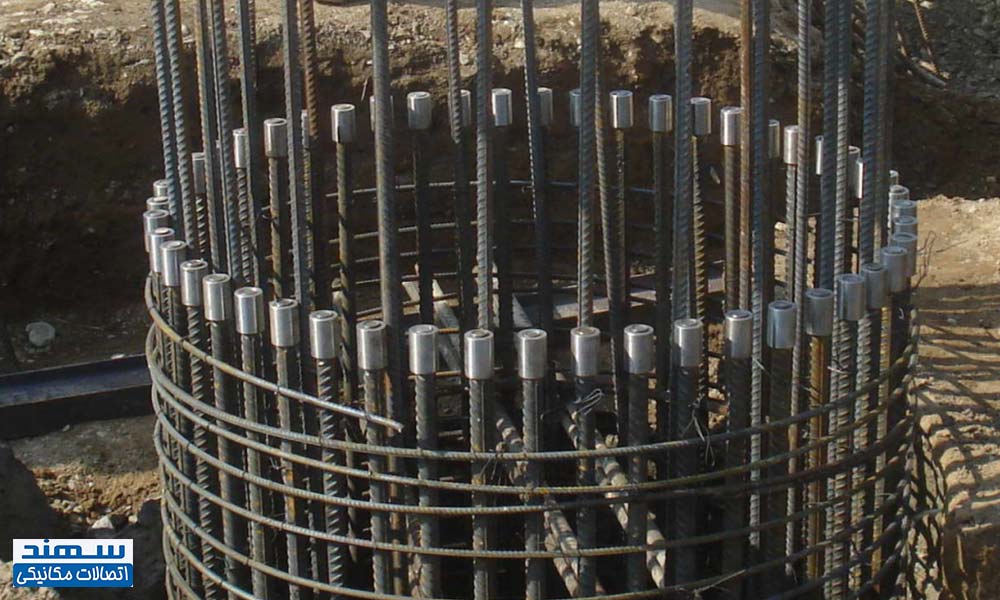
In this article, we will provide explanations about Iranian National Standard No. 12723 regarding mechanical connections or rebar couplers and publish the Standard No. 12723 file for download. This standard has been published in two sections titled “Requirements” and “Test Methods.” The complete details are available within the file, and we will briefly explain its important sections.
Requirements of Standard No. 12723
The Institute of Standards and Industrial Research of Iran is the only official authority in the country responsible for establishing, developing, and publishing Iranian national (official) standards. These regulations were approved on 18/12/2009 and their purpose is to define the requirements for rebar couplers used in steel reinforcement connections. They specify the requirements for couplers used in mechanical connections of reinforced concrete structures and are applicable to various reinforced concrete design standards and steel reinforcement bars.
The requirements for couplers are based on the following tests:
A- Strength and toughness under static loads
B- Slip under static loads
C- Performance under high-cycle loading within the elastic range
D- Performance under low-cycle reversed loading within the elastic-plastic range
Items A and B are mandatory for all couplers, while items C and D depend on specific conditions, with further explanations provided in Annex C of the standard file.
Below are some of the most important points of this standard:
– If mechanical connections fail to achieve the acceptance criteria in the tensile strength test outside the mechanical connection length, no further examination of tensile strength or toughness of the mechanical connections is required.
– Each coupler must contain information including the manufacturer’s details, rebar size and dimensions, and a traceable batch identification mark.
– The manufacturer must prepare clear written instructions, and the coupler installation process must be fully accessible at the construction site.
To verify the compliance of couplers with the requirements of this standard, there are two methods: one through a certification system, where an organization provides certification, and the other through individual batches. Each of these methods has separate conditions, which are explained in Annexes A and B.
Test Methods of Standard No. 12723
The purpose of publishing this standard is to define applicable test methods for mechanical couplers used in steel reinforcement bar connections. All tests must be performed on mechanical connections manufactured using the same production method intended for normal use, and the coupler installation instructions must be provided to the laboratory.
The test methods specified by this standard include:
A- Tensile Test:
In this test, the strength and toughness are evaluated, and the failure location must be examined in one of the following two conditions: “within the mechanical connection length” or “outside the mechanical connection length.”
B- Slip Test:
Slip measurement must be performed based on the maximum external dimension and the total dimensions of each section. If the coupler includes more than one load-transfer component, it is recommended that additional slip measurements be performed between each load-bearing section. The test specimen must be placed in rigid equipment so that the load is transferred axially and, as much as possible, remains free from any bending moment along the entire length of the specimen.
C- High-Cycle Fatigue Test:
The purpose of this test is to determine the fatigue strength of mechanical connections. In an axial fatigue test, the specimen is subjected to an axial tensile force that oscillates periodically in a sinusoidal waveform with a constant frequency within the elastic range.
It should be noted that, in general, fatigue performance tests of mechanically connected rebars usually show slightly lower performance compared to unconnected rebars.
D- Low-Cycle Fatigue Tests:
These tests are performed in two forms:
A) Alternating tension and compression test with high stresses in mechanical connections:
The purpose of this test is to simulate the reversed elastic loading of the reinforcement system during a moderate earthquake.
B) Alternating tension and compression test with large strains in mechanical connections:
The purpose of this test is to simulate large reversed elastic-plastic loading of the reinforcement system during a severe earthquake.
– The test reports must include information such as reference to this standard, the name of the laboratory, the name of the test requester, and other required details, which are provided at the end of the file.
The products of Sahand Mechanical Splices have successfully passed all Standard No. 12723 tests that are available to perform within the country. In addition, they have successfully undergone various tests in other countries equipped with the technology required to conduct the tests specified in Standard No. 12723. Documentation of the successful performance of these products in these tests is proudly provided on the download page for interested users.