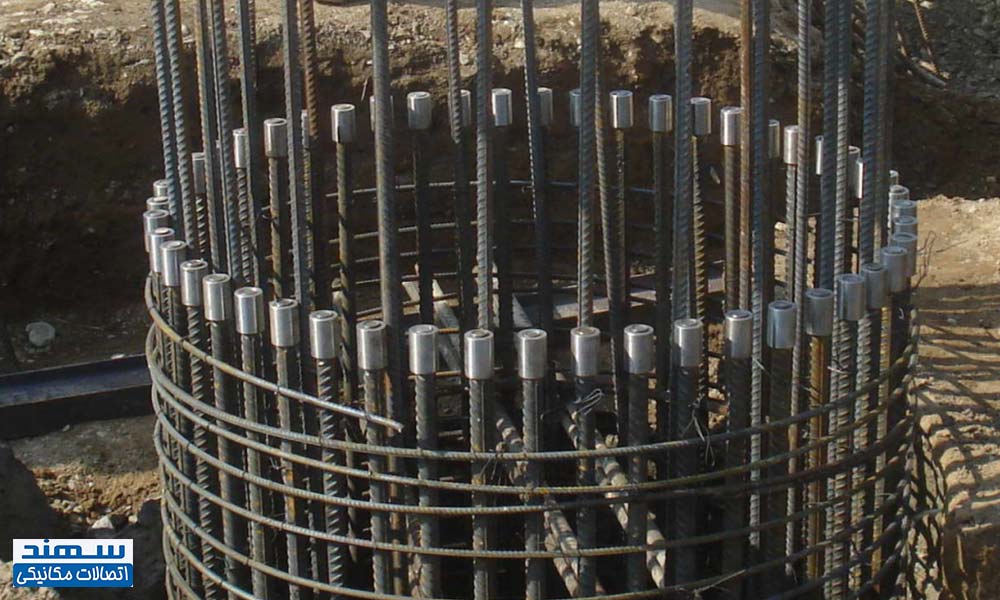


As we know, a coupler is a mechanical component designed to connect two threaded rebars together in such a way that the two separate rebar pieces function as a single continuous bar. Currently, there are two common types of couplers available in the market: straight thread couplers and taper thread couplers. The difference between these two types lies in the threaded section of the couplers.
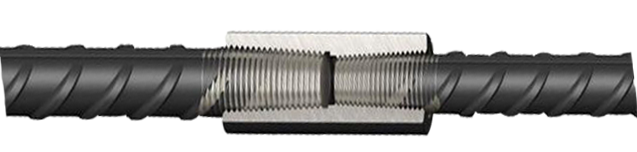
In a straight thread coupler, the coupler and the rebar are aligned in a straight manner, and most available couplers are manufactured using this method. The following figure shows a straight thread coupler.

However, in a taper thread coupler, the threaded section of the coupler is designed in a conical shape, and the rebar is also threaded in a tapered form. As shown in the figure below, the coupler and the rebar are connected together within a conical threaded interface.
In this article, we intend to explain the advantages and disadvantages of each type and ultimately introduce the best type of coupler. Considering the increasing use of mechanical splices in our country, it is necessary for respected users to have complete knowledge of the products available in the market, evaluate and compare them with one another, and then select the appropriate product.
Comparison of Straight Thread Couplers and Taper Thread Couplers
1- Creating straight threads at the end of the rebar as well as inside the coupler ensures complete engagement between the coupler threads and the rebar end threads, because the threads are formed along two parallel lines. The only requirement is to control the tolerance between the coupler threads and the rebar threads at the end of the bar so that it does not exceed the permissible limit. This tolerance can be easily controlled using Go and No-Go gauges. However, in the tapered thread method, matching the angles of the cones created on the coupler and the rebar threads is not easily achievable. Even if the cone angles differ by only 0.5 degrees, some sections of the coupler and rebar threads will not engage with each other, and force transfer will occur through only a small portion of the threads. As a result, the strength of the tapered mechanical splice will be reduced.
2- The length of a straight thread coupler is approximately 30% shorter than that of a tapered thread coupler, resulting in lower costs and savings in raw materials.
3- Taper threads are created using cutting tools and through a material removal process, which requires proper tool selection and careful monitoring of tool performance. In simpler terms, tool wear in the tapered threading method is very high. Therefore, after producing only a small number of tapered threads, the tool must be replaced; otherwise, the quality of threading rapidly decreases, and the created threads will practically be unable to transfer the applied forces to the rebar.
4- Taper thread couplers do not provide tensile strength equivalent to straight thread couplers. Generally, during tensile testing, the threaded rebar either pulls out from inside the coupler or fractures at the threaded section. In contrast, in straight thread couplers, failure generally occurs in the rebar itself and away from the coupler.
5- To tighten tapered thread couplers, a special torque wrench must be used. However, straight thread couplers do not require a special wrench, and tightening the rebars until the last thread is fully engaged indicates that the coupler installation process has been completed.
6- In tapered thread couplers, it is not possible to create left-hand threads on the rebar. Therefore, products such as left-and-right couplers cannot be manufactured using this type of coupler. In contrast, in the straight thread method, creating left-hand threads is as simple as creating right-hand threads.
7- Monitoring proper tightening in tapered thread couplers requires torque wrench control and necessarily requires specialized personnel. However, in straight thread couplers, the complete engagement of the rebar threads inside the coupler indicates that the installation process has been performed correctly.
8- The only advantage of tapered thread couplers is the easier initial engagement between the rebar and the coupler during the first stage of tightening. Due to the conical shape of the threads, inserting the rebar into the coupler is performed more easily.
Based on the above comparison, it can be concluded that straight thread couplers are technically and practically superior to tapered thread couplers, and their reliability is significantly higher than the latter type.
To order Sahand Mechanical Splices products, you can contact us at +98 21 44024118 and receive further information regarding your required product. You can also visit the Rebar Coupler page to learn more about different types of couplers and become familiar with their applications.