

Based on the information provided in Sahand’s articles section and the knowledge gained about mechanical splices and couplers, it is now time to learn more about the different types of couplers.
At first glance, a coupler may appear to be a simple component used to connect two rebars together. However, in large-scale construction projects, different types of couplers are required to meet various structural requirements and applications.
In this article, we will provide comprehensive information about the different types of couplers and their specific applications. You can also watch the following video to gain a complete understanding of the various coupler types.
Standard Coupler
When talking about couplers, the first type that usually comes to mind is the standard coupler, also known as a right-hand threaded coupler. This is the most commonly used type of coupler in construction projects.
When connecting rebars using this coupler, it can still be used even if one of the rebars is fixed and cannot be rotated. In this case, the coupler is first connected to the rebar that cannot rotate, and then the second rebar is connected to the other side of the coupler. The majority of couplers manufactured at Sahand’s factory are of this type, and they are widely used in various structures.
Left and Right-Hand Threaded Coupler
When a project requires connecting two rebars where neither bar has enough space or the ability to rotate, a left and right-hand threaded coupler is used.
In this method, one rebar is threaded with a right-hand thread and the other with a left-hand thread. The coupler is also manufactured with a right-hand thread on one side and a left-hand thread on the other. By rotating the coupler, two fixed rebars can be securely connected together without requiring the rotation of the rebars themselves.
End Coupler
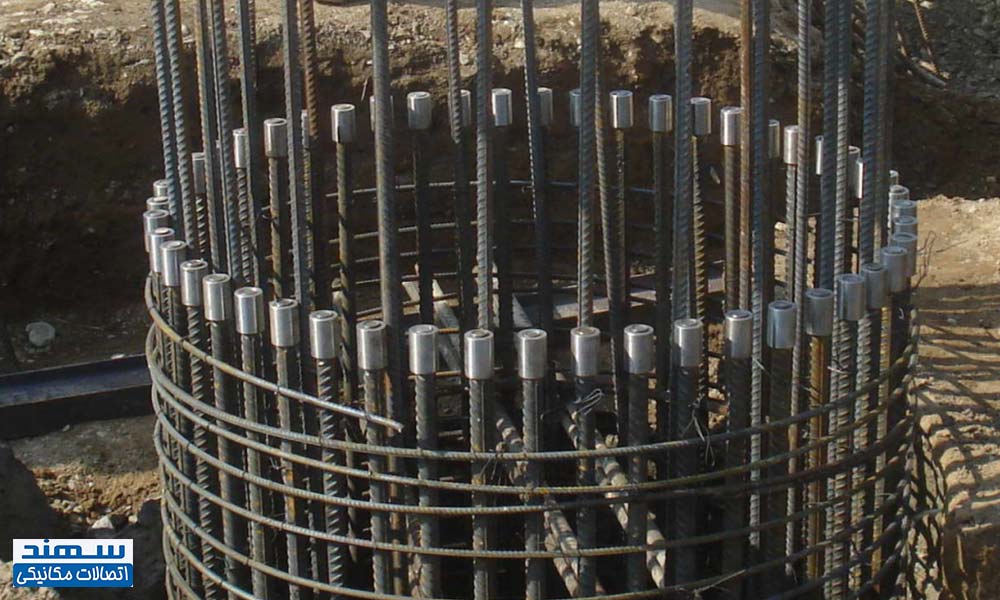
If you have observed reinforcement installation in a construction project, you may remember that the ends of rebars are often bent to ensure proper anchorage and secure positioning within the concrete. An end coupler is one of the types of couplers designed to replace this bending process, eliminating the need for rebar end bending.
In areas where beams and columns intersect, reinforcement congestion can become a major challenge. Using end couplers reduces reinforcement congestion in these areas, creating more space for proper concrete flow and improving the quality of concrete placement. You can also read our article on the advantages of end couplers for more information.
Reducing Coupler
In some construction projects, it is necessary to connect two rebars of different diameters along the same axis. A reducing coupler is specifically designed for this purpose, allowing rebars with different sizes to be connected securely and efficiently.
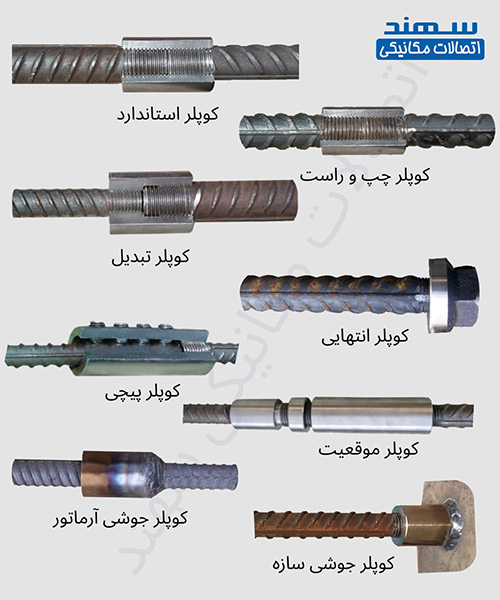
Bolted Coupler
Sometimes, due to reinforcement installation errors or other issues, the length of a starter bar may become too short. A starter bar is the section of reinforcement that extends outside the concrete and must be connected to another rebar so that the column can continue to the upper levels.
If the starter bar has sufficient length, lap splicing can be used. However, when the starter bar is too short, lap splicing is no longer a suitable solution, and a bolted coupler is the only practical option, even if the existing starter bar has not been threaded beforehand.
In this method, the starter bar is secured inside the coupler using several side bolts, eliminating the need for threading. The next rebar can then be connected to the bolted coupler through a threaded connection.
Structural Welded Coupler
In some steel structure projects, it is necessary to connect a rebar to a steel component. In such cases, a structural welded coupler, which is one of the types of couplers, is used.
The structural welded coupler is welded directly to the building’s steel frame, and the threaded rebar is then connected to the coupler, creating a secure and reliable connection between the steel structure and reinforcement.
Rebar Welded Coupler
When a coupler needs to be welded to a rebar from one side or both sides, a rebar welded coupler is used. This type of coupler is designed to allow welding on either one side or both sides of the reinforcement bar.
A rebar welded coupler can also be used as an alternative to a bolted coupler, especially in situations where the starter bar length is too short and lap splicing is not possible.
Position Coupler
A position coupler is one of the types of couplers designed to connect two rebars while allowing length adjustment. It works through a threaded mechanism, where two separate components are tightened together and secured with a locking nut to adjust the required length.
This type of coupler is used in special situations where it is necessary to fill the gap between two rebars and achieve a precise connection length.
Sahand Mechanical Splices, with years of experience in manufacturing various types of couplers, is ready to establish cooperation agreements with construction companies. For free consultation regarding contract terms and project requirements, please contact us at +98 21 4402 4118. Customers can also visit the company’s head office on Ayatollah Kashani Street for further information.