

Disadvantages of Forge Welding | Disadvantages of Butt Welding
Before discussing the disadvantages of butt welding or forge welding, Sahand Mechanical Splices would like to clarify that the following information is provided solely to familiarize respected users with the disadvantages of this method and does not, in any way, represent criticism or evaluation of the working methods of any companies or individuals providing butt welding services in Iran. The Sahand Industrial Group is ready to participate in scientific and technical review sessions regarding this method with supporters and service providers of this technology, in the presence of expert academic specialists and respected users, at any place and time.
Butt welding is one of the methods used for rebar connection, in which two rebars are heated using a torch, and when the two rebars reach a plastic state, they are pressed together with significant force until they are welded to each other. In this method, no welding filler material is used, and the quality of the work depends on the skill of the welding operator.
First, it is necessary to briefly refer to the types of permitted welding methods according to Clause 9-21-4-1-6 of the National Building Regulations, 2013 edition, and then proceed to discuss the disadvantages of butt welding or forge welding.
Clause 9-21-4-1-6 of the National Building Regulations
According to Clause 9-21-4-1-6 of the National Building Regulations, welded splices of rebars, or butt welding, also known as forge welding, must be performed using one of the following methods: plastic butt welding (resistance welding) or fusion welding with electrodes (arc welding). The tensile strength of these splices must be at least equal to 1.47(Ab fyd), unless the requirements of Clause 9-21-4-2-2 have been satisfied.
According to this clause of the National Building Regulations, two types of welded rebar connections are approved:
1- Plastic butt welded connection (resistance welding), which is only permitted under factory conditions.
2- Fusion welded connection with electrodes (arc welding).
It appears that, considering the revision of the National Building Regulations in 2013 and the several years of experience with the use of gas pressure butt welding (GPW) in Iran, this method still does not have a position within the National Building Regulations.
For information on the requirements of the manual gas pressure welding method for rebar using acetylene gas and pressure, as approved by the Road, Housing and Urban Development Research Center, click here.
The welded connection method introduced in Iran as a method for rebar splicing is known as Gas Pressure Welding (GPW) in Japan (gas pressure welding, which has been incorrectly named “forging” by one of the Iranian providers of this method). This technology dates back to the 1960s and is not only not commonly used as a standard method or an alternative to mechanical splicing in technologically advanced countries, but even in the country of origin of the welding fixture technology, following the Kobe earthquake in Japan and the review of unfavorable performance results of this connection, its use is only permitted under very strict requirements and detailed guidelines.
The disadvantages of butt welding will be discussed in the following sections.
10 Disadvantages of Forge Welding and Factors Affecting Reliability
Due to the inability to measure physical and mechanical parameters in this method, the involvement of multiple factors during the welding process, and the accumulation of various human, environmental, and machinery-related errors, the reliability of this method is significantly reduced. The disadvantages of butt welding and the factors affecting the reduction of its reliability are briefly described below:
1- Welding operator skill
2- Failure to implement or incomplete implementation of WPS and PQR procedures
3- Lack of control over the heat generated by the oxy-acetylene flame
4- The heating time of the rebar is approximate, and the operator performs the process based on personal experience
5- The length of time for heating the rebar is approximate and based on the operator’s experience, and there is no tool available for controlling it
6- It is not possible to control the temperature of the rebar during the heating process, while reaching the desired temperature is one of the most important and effective parameters in achieving proper fusion between the two rebars at the connection interface
7- The effect of ambient temperature on cooling the welded area and consequently making it brittle
8- The hydraulic system pressure required to compress the two rebars and create fusion between them has a direct relationship with the temperature of the connection area. This means that if the temperature of the connection area varies, which is determined approximately and experimentally by the operator, while the same pressure is applied by the hydraulic system, the resulting connections will not be identical and will not have uniform quality
9- Due to the variety and lack of uniformity in the rebar production process, as well as their different behavior during heating, the possibility of achieving the desired result is significantly reduced
10- In addition to the above-mentioned factors, and considering the limitations stated in Clause 21.1.7.1 of the ACI 318-11 Code, lap splice limitations still apply to welded connections. Therefore, not only is rebar waste not reduced, but implementation costs are also higher compared to lap splices. According to this clause of the code, it is not possible to increase the length of starter rebars using this method. However, unfortunately, this method is observed in some projects for extending starter rebar lengths. Therefore, it is necessary for supervising authorities to strictly consider compliance with the relevant codes and regulations in this regard.
Considering the factors affecting welding quality using this method and the disadvantages of butt welding, the reliability of this method is reduced by at least 50%. This means that out of every 100 welds performed, 50 welds would be unacceptable. The only way to ensure welding quality is to perform ultrasonic testing (UT). However, due to the high costs of conducting such tests and the difficulty of achieving the requirements specified by the Road, Housing and Urban Development Research Center for this method, it becomes extremely difficult and costly, ultimately eliminating any economic justification for using this method.
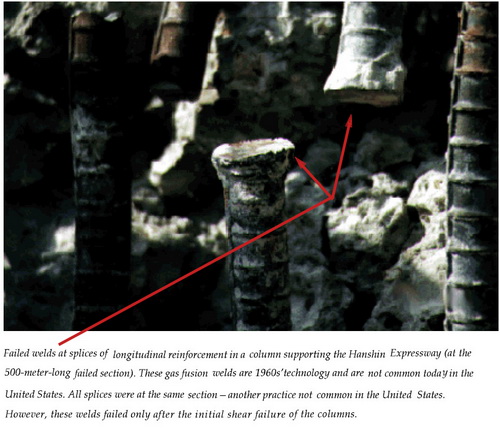
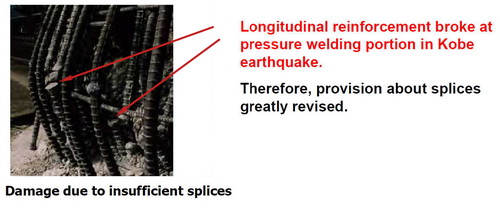
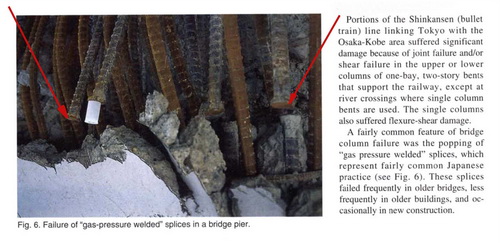
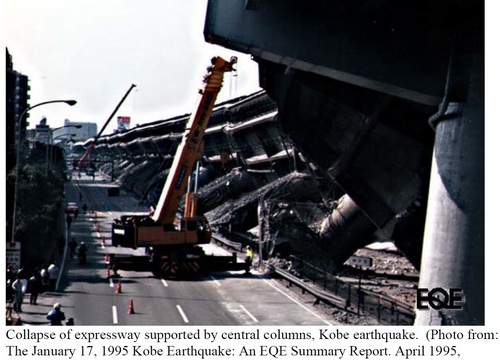
Examples of Failure of Welded Connections (GPW) in the Kobe Earthquake, Japan
As mentioned earlier, this method was used in Japan in the past. However, following the Kobe earthquake in Japan, images of which are provided below, the level of confidence in this method significantly decreased, and it was no longer used in advanced countries.
Despite the fact that the welds were performed by skilled Japanese operators, with strict supervision of the welding process and the implementation of quality control tests, the results obtained from this method proved to be catastrophic and were by no means reliable.
Assuming that the quality of welding performed by individuals and companies implementing this method in Iran is equivalent to the quality achieved in Japan, unfortunately, the final outcome would be similar to the results observed after the Kobe earthquake in Japan, which represents one of the disadvantages of butt welding.
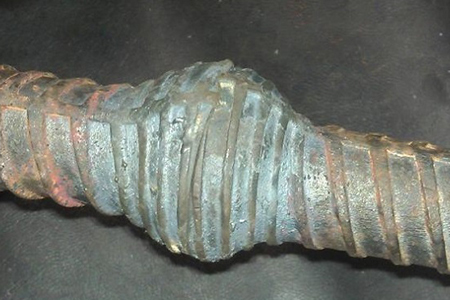
Another Example of the Disadvantages of Butt Welding
Rebar welded using the Gas Pressure Welding (GPW) method. These two rebars have been connected using the forge welding or butt welding method, and apparently, a proper connection has been established.
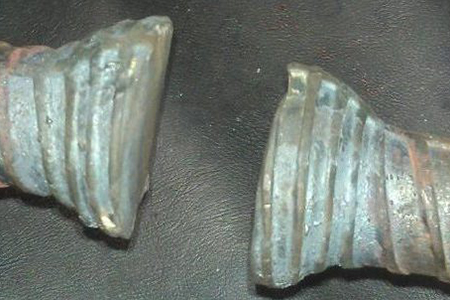
The same rebars that were connected by butt welding in the previous image fractured after slipping from the operator’s hand and hitting the ground.
Sahand Mechanical Splices recommends that respected project owners and builders use mechanical splicing with couplers instead of any other connection method, in order to achieve a more cost-effective structural solution while significantly improving structural strength and reliability.
For further information and free consultation regarding construction projects, respected builders can contact the Sahand company office at +98 21 44024118.